
May 5, 2025
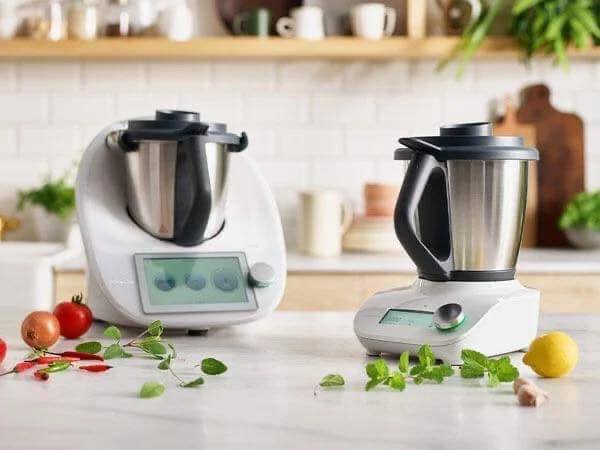
Some people call it the best kitchen helper, the fairy of the home, the magic wand, or simply the best friend in the kitchen (as I do). The truth is that once you’ve bought a Bimby, your life in the kitchen is never the same again. Everything can be done at home and that fear or apprehension that I’m not good in the kitchen is gone. Fantastic, isn’t it?
But in order to get the most out of our friend, make the most of the investment and thus have more time to do what we love, I’m sharing with you some tips and tricks that will help us in this process. Wonderful!
To begin with, it’s important to get to know your friend well, and understand how the timings work, each of its functions and which temperatures are suitable for each one in order to do even more, for less.
Let’s see,
TIPS
Temperatures
To get the best out of each recipe, you need to know how to use the machine correctly, and that means knowing the right temperature for each dish. For example:
- 37ºC: ideal for heating up baby food, liquid ingredients for soft doughs and for beating cakes;
- 50ºC/60ºC: bain-marie for melting chocolate and heating milk to make yogurt;
- 70ºC/80ºC/90ºC: bain-marie for sauces, cooking with milk or cream:
- 100ºC/120ºC: for stewing, stewing or boiling, steaming and simmering, sautéing, sautéing and making reductions.
Cooking and saving
In its simplest form, the Bimby is already a great helper that will optimize the time you spend in the kitchen and even help us save on the budget, however, there are several tips to achieve even more and better. For example:
- Cook on three levels: use the cup, basket, varoma and varoma tray to make more than one recipe at the same time. In one go, you can make soup, a main course and even dessert;
- Make the most of the varoma: when making soup at the same time, prepare the main course or dessert in the varoma; place the ingredients on greaseproof paper so the flavors don’t mix;
- Put the butterfly to good use: use the butterfly to beat the mashed potato and don’t exceed speed 3 to get a lighter, fluffier mash;
- Vegetables: those that need to be cut (potatoes, carrots, pumpkin, etc.) should be broken into small pieces of the same size so that they cook evenly.
Tricks
1.Using the measuring cup to shape cookies: One of the great uses of the measuring cup is to measure the quantities of ingredients, but that’s not all, this utensil is spectacular for shaping cookies. They turn out the same, with a good size and the dough doesn’t stick together. Wonderful.
Separate the yolks from the whites: crack the egg on top of the lid, with the lid on, lift the measuring beaker slightly and wait for the whites to slip into the beaker. Simple, easy and effective.
Use the varoma as a colander for pasta and vegetables: For the days when we cook this type of food in large quantities, the varoma can be used as a colander. It has much more capacity than a normal-sized one and doesn’t let the water overflow. Only advantages.
Substituir o cesto pelo copo de medida para obter compotas perfeitas: Quando cozinhamos compotas ou caldas, é necessário que o vapor saia, para que reduzam, e fiquem no ponto. Contudo, o copo de medida retém o líquido, e a receita acaba por não atingir o resultado esperado. No entanto, se substituirmos este utensílio pelo cesto, o vapor acaba ser libertado, sem retenção de fluídos desnecessários, deixando as nossas caldas e compotas bem apuradas.
Don’t use the butterfly above Vel. 4: The butterfly is undoubtedly one of the most spectacular parts of the Bimby, but when used above Vel. 4, the blades can cut it, and it leaves pieces of plastic in the food, which can be dangerous for our health.
Add milk to leftover chocolate: Whenever we melt chocolate, the leftovers stick to the base of the blade and end up getting lost in the wash. However, there is a delicious way to use them: Add 300 gr of milk and blend for 5 sec/speed 8. Then heat for 5 minutes at 80ºC/speed 4 and you have a delicious hot chocolate with zero waste. Only advantages and good things.
Whipping the egg whites at the beginning of the recipe: There’s nothing worse than washing the bimby’s bowl halfway through the recipe, for example, in the case of chocolate mousse, preparing almost the entire recipe, having the bowl super dirty, and then having to whip the egg whites at the end, where the bowl needs to be clean. To avoid this and other situations, first of all, read the recipe all the way through and check the steps. This way, you avoid wasting time, detergent and ingredients.
For more tips, tricks and even meal suggestions to make even more with our friend, check out the book “A Bimby Faz”.
Share

About us
Work Quality offers training and consultancy in safety, food hygiene and personal development with a focus on excellence and updating.

Contacts
- +351 918 313 851
- geral@workquality.pt
- Estrada dos Portões Vermelhos n.º 20, 9560-450, Lagoa, Gabinete 11
